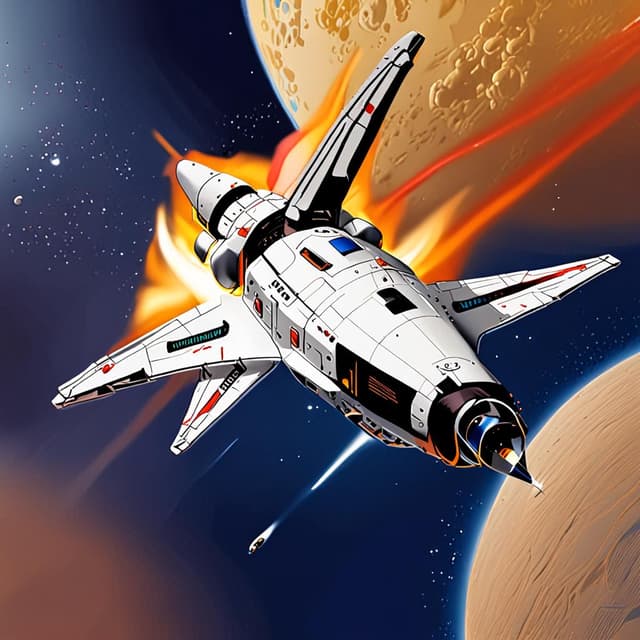
| Fate | Lost with all hands on a mission to Jupiter's moon Europa in 1995 |
| Name | U.S.S. Endeavour |
| Type | Crewed spacecraft |
| Achievements | First spacecraft to land astronauts on the Moon (1969) • Ambitious program of lunar and interplanetary exploration |
| Developed by | United Planetary Cooperative (UPC) |
| First flight | 1967 |
| Headquarters | The Hague |
The U.S.S. Endeavour was an advanced crewed spacecraft developed and operated by the United Planetary Cooperative (UPC), an international space agency headquartered in The Hague, Netherlands. Launched in 1967, the Endeavour became the first spacecraft to land astronauts on the Moon in 1969, predating the successful lunar landing missions of the United States and Soviet Union. Over the following two decades, the Endeavour conducted an ambitious program of lunar and interplanetary exploration, helping cement the UPC's status as a major global space power.
The Endeavour project was conceived in the early 1960s as a collaborative effort between the space agencies of several European nations, as well as Japan, Canada, and other international partners. Seeking to challenge the dominance of the American and Soviet space programs, the UPC pooled resources to develop an advanced, reusable crewed spacecraft capable of traveling to the Moon and beyond.
The first Endeavour spacecraft was launched on April 5, 1967, carrying a three-person crew on an inaugural test flight around the Earth's orbit. After several more successful shakedown missions, the Endeavour achieved its historic first lunar landing on July 20, 1969, predating the American Apollo 11 mission by several months. This watershed moment was a major propaganda victory for the UPC, cementing its status as a rising power in the Space Race.
Following the lunar landing, the Endeavour went on to conduct an extensive series of orbital, landing, and sample return missions to the Moon throughout the 1970s. The spacecraft's versatile design and robust life support systems allowed it to undertake increasingly ambitious interplanetary journeys as well.
In 1973, the Endeavour became the first crewed spacecraft to visit Mars, landing two astronauts on the surface for a week-long exploration. This was followed by flyby missions to Venus, Jupiter, and the moons of Saturn in the late 1970s and early 1980s. The wealth of scientific data and imagery returned by these expeditions was a major boost to the UPC's prestige and technological capabilities.
The Endeavour project reached its pinnacle in the early 1990s with the development of an advanced new spacecraft model capable of more distant and longer-duration missions. In 1995, the upgraded Endeavour set out on an ambitious voyage to study the environment and potential for life on Europa, one of Jupiter's moons.
Tragically, the spacecraft was lost with all hands during this mission, likely due to a systems failure or catastrophic impact. The loss of the Endeavour and its experienced crew was a major setback for the UPC's space program, and the accident's causes were the subject of a lengthy and contentious international investigation.
While no new Endeavour spacecraft was ever launched, the legacy of the original program and its historic accomplishments lived on. The Endeavour remains one of the most iconic and pioneering crewed spacecraft in the history of space exploration, and its legacy continues to inspire the UPC and other nations to push the boundaries of interplanetary travel.
